Lens
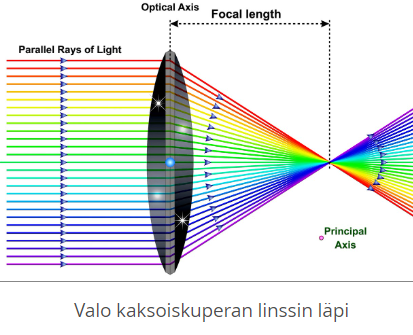
The lens specifies or dissipates the light by folding, and unlike the prism, the principle of which folds without precision, the lens specifies the light, forming the image. In general, the lenses are made of glass or plastic, but there are also liquid lenses that use the principle of the human eye precision mechanism. Glass lenses are made to the desired shape by grounding and polishing, while plastic lenses are made by pressing.
Approaching lenses
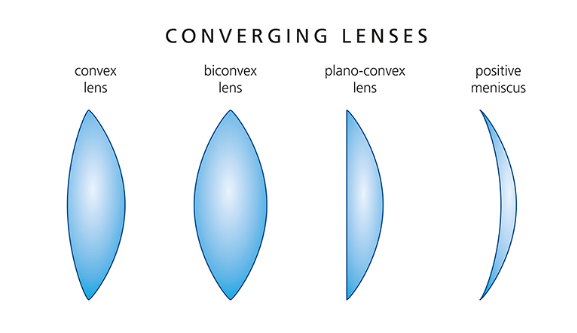
Simple lenses classified in principle into eight types according to the curvature of two optical surfaces. Approaching lenses
- Kupera lens
- Double persian lens
- Flat convex lens
- Positive meniska
Diversifying lenses
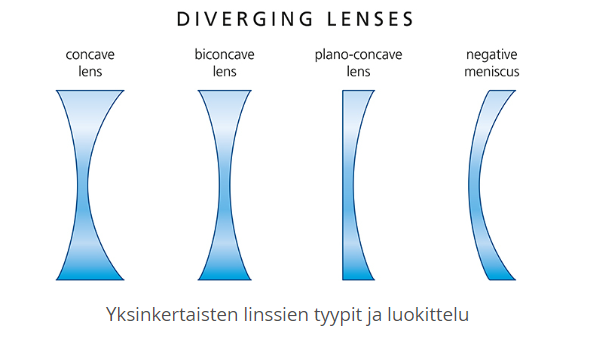
Diversifying lenses
- Concave lens
- Double concave lens
- Plano- concave lens
- Negative menu
A combination lens usually refers to a lens made by combining two or more lenses, such as a convex lens, which collects light and concave lens, which emits light. This combined lens reduces chromatic aberration, such as image distortion and light stripes, which cannot be reduced when only one lens is used. The types of lenses are spherical lens, cylindrical lens, infrared optics, ball lenses, group lenses and many other optical lenses in the field.
Type of lens
Ball-shaped lens: The skilful surface of the spherical lens has spherical curvature. The ball-shaped lens is first divided into a convex and concave lens and divided again into the plane, double lens and meniski from the first division.
Aspheric lens: This lens is made of a curved surface other than a spherical surface. It is designed to reduce the number of lenses by minimising the orbital defect and bringing the focus together, leading to a clean picture with minimal distortion.
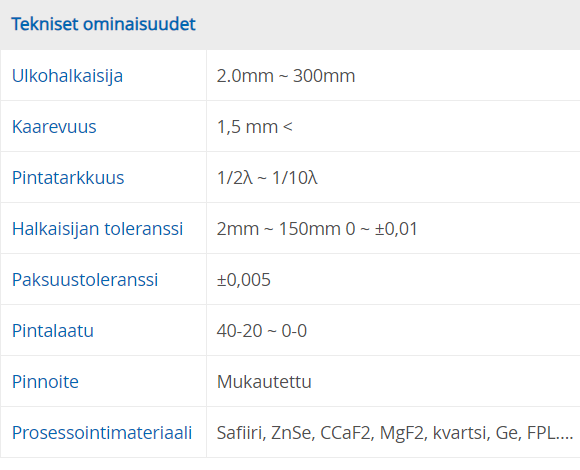
Cylindrical lens: The cylindrical lens specifies or increases light only within one axis of the light source. These cylindrical lenses are used to focus light on thin lines in optical metrology, laser scanning, spectroscopy, laser diodes, acoplastic and optical processor applications. The materials of cylindrical lenses are N-BK7 glass, UV-fused silica or CaF2.
Acromatic lens: The acromatic lens has excellent off-axis performance and is designed so that the focal length is constant regardless of the aperture and operating wavelength. It is manufactured as a duplex or triplex and is suitable for applications that require better colour correction in the visible wavelength range. These lenses are often used in applications that require more analytical observation, such as microscopes and medical devices.